
Agentic AI vs. Generative AI: Why 2026 is the Year of Autonomous Agents
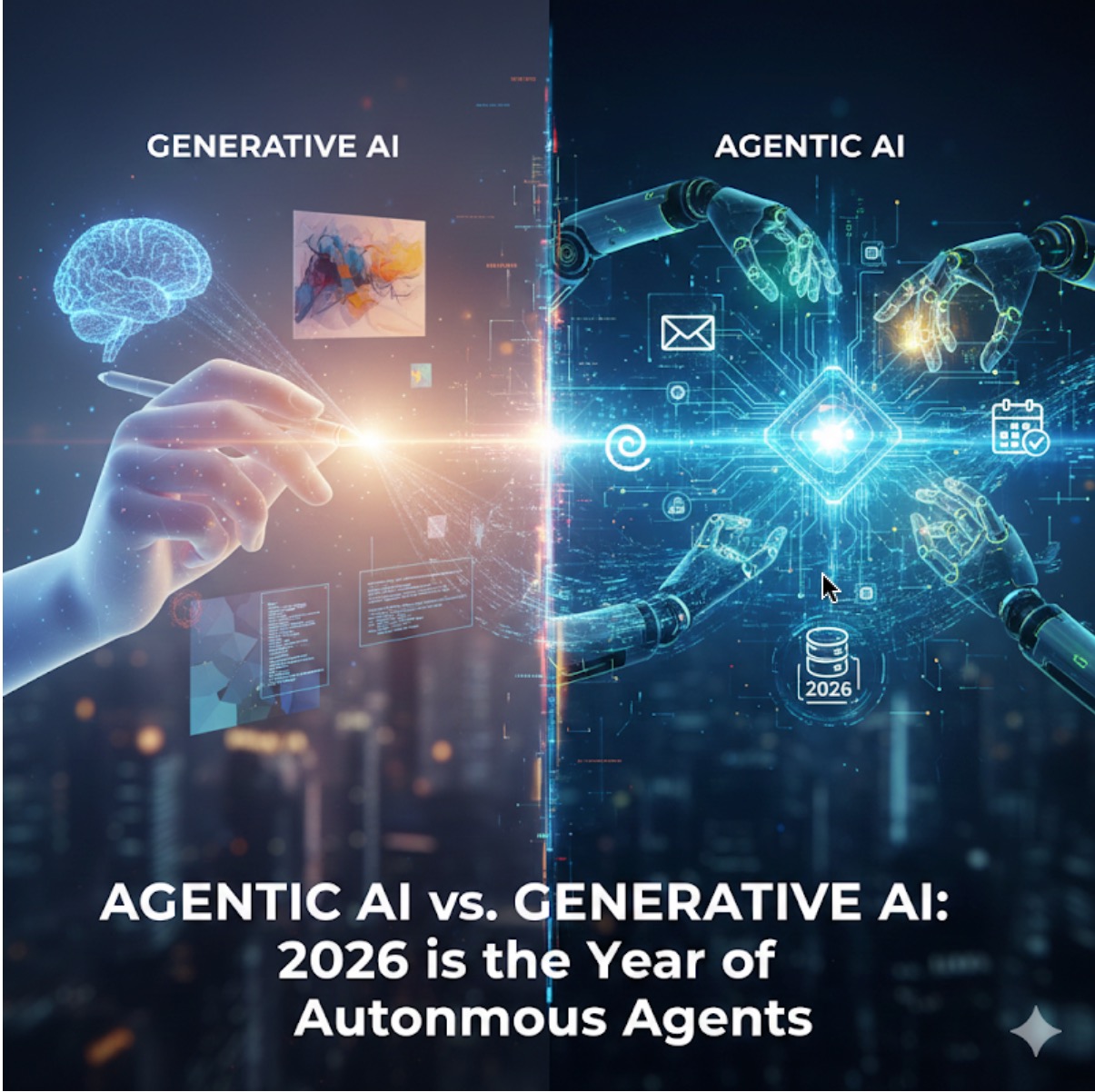
The tech world loves a good buzzword. For the last few years, the reigning champion has been Generative AI —a phrase that conjures up images of ChatGPT writing poetry, Midjourney creating stunning art, and GitHub Copilot helping developers code faster. .
But if you’re a CIO, a developer, or a business leader planning your technology roadmap for 2026, you need to recognize a fundamental truth: The era of purely generative AI is giving way to the age of Agentic AI >.
It’s not a replacement, but an evolution—a shift from an AI that thinks and creates to an AI that thinks, creates, and acts autonomously to achieve complex, real-world goals. This isn't just a technical upgrade; it’s a paradigm change that redefines the very nature of automation, and it’s why savvy businesses are rapidly pivoting their AI Development Services strategy to focus on autonomous agents.
Part I: Defining the Shift — From Creation to Execution
To understand why 2026 belongs to Agentic AI, we first need to clearly distinguish it from its predecessor.
The Generative AI Paradigm: The Brilliant Assistant
Generative AI (GenAI), powered by modern Large Language Models (LLms), like GPT and Gemini, is fundamentally a creative and reactive technology.
What GenAI Does Best:
- Creation: It generates new content—text, code, images, video, and music—based on a specific human prompt.
- Analysis: It can summarize vast documents, analyze sentiment, and identify complex patterns in data.
- Augmentation: It acts as an incredibly powerful assistant, augmenting human creativity and productivity.
- The Core Limitation: Generative AI is like a brilliant essay writer who hands you a perfect paper but cannot turn it in, talk to the professor, or apply the lessons learned. It stops at the output; the human must take the next action.
The Agentic AI Paradigm: The Autonomous Colleague
Agentic AI, on the other hand, is an entire system built around goal-driven action and decision-making. It uses a Generative AI model as its brain but its purpose is to be an executor and a proactive colleague.
What Agentic AI Does Best:
- Autonomy: It operates independently without requiring a prompt for every step. Once a high-level goal is set, it executes the entire workflow.
- Goal-Driven Execution: It can break down a complex task (e.g., "Launch a new marketing campaign") into a multi-step plan (Research, Draft Copy, Generate Image, Schedule Posts, Track Performance).
- Tool Use & Action: It’s equipped with a “toolbox” of external APIs and systems (calendars, email, CRM, databases). It can act in the real world—sending emails, updating records, booking appointments, or autonomously debugging code.
- Adaptability & Learning: It collects feedback from its environment after an action, learns from the result, and adapts its future plans to be more effective (Reinforcement Learning).
| Feature | Generative AI | Agentic AI |
|---|---|---|
| Primary Goal | Create content (text, image, code) | Execute actions & achieve goals |
| Core Function | Reactive; responds to a prompt | Proactive; initiates a workflow |
| Autonomy Level | Low; human input at each step | High; operates independently |
| Real-World Action | None; output is static content | High; integrates with tools/APIs to act |
| Best Analogy | A brilliant Suggestor/Drafter | An autonomous Doer/Manager |
Part II: Why 2026 Marks the Tipping Point
The technology to build AI agents has existed for decades, but the confluence of three major factors is making 2026 the breakout
1. The LLM Brain Power Leap
The dramatic improvements in Large Language Models have given AI agents the crucial component they always lacked: the ability to reason and plan with human-like understanding. An Agentic system uses the LLM to perform four core functions:
- Perception: Analyzing data from its tools (e.g., "The CRM shows the customer is unhappy").
- Reasoning: Determining the current context and identifying the problem.
- Planning: Breaking the goal into sequential, actionable steps (e.g., "Step 1: Check support history. Step 2: Draft follow-up email. Step 3: Schedule a manager review.").
- Self-Correction: Evaluating the outcome of an executed step and adjusting the plan dynamically.
This ability to dynamically plan complex workflows is what separates modern Agentic AI from simple scripts or traditional
2. The API Economy & Tool Integration
Modern IT infrastructure is a vast ecosystem of interconnected APIs (Application Programming Interfaces). Today, nearly every major business tool—from Salesforce and Jira to Slack and SAP—is accessible via a robust API.
Agentic AI excels precisely because it can utilize these APIs as its tools. The agent doesn't need to be coded for every single possibility; it learns to use the documentation of an API to achieve its goal.
The core shift: The agent moves from being a specialized, bespoke tool to becoming a generalized workflow engine that orchestrates hundreds of existing enterprise systems.
3. Enterprise Demand for “True” Automation
The initial wave of GenAI provided amazing efficiency gains in content creation and code drafting. However, enterprises quickly hit a ceiling. They still required a human to copy the generated text, paste the drafted code, and push the "Go" button. This created a new "last mile" bottleneck.
Businesses are no longer looking for tools to help employees write faster; they are looking for AI Development Services that can deliver solutions to run the business autonomously. This appetite for end-to-end process automation is the primary driver pushing Agentic AI into mainstream adoption.
Part III: The Autonomous Revolution—Agentic AI Use Cases
Agentic AI isn't just for coding; its impact spans every department, transforming business processes and creating entirely new categories of efficiency.
1. Autonomous Software Development
This is the most talked-about area. Agentic AI can evolve beyond code suggestion to become a genuine "AI teammate."
Goal: Resolve a reported bug in the production environment.
Agentic Workflow:
- Perceives a Jira ticket and log data from the monitoring system.
- Reasons that the bug involves a dependency issue in a specific microservice.
- Plans by creating a feature branch, writing a test to replicate the bug, generating the patch code, and running the test suite.
- Executes by committing the code and submitting a pull request for human review.
This dramatically accelerates the development lifecycle and frees human developers for higher-level architectural work.
2. Financial Services & Risk Management
Goal: Proactively manage fraud and risk across an institutional account portfolio.
Agentic Workflow:
- Perceives real-time market data, transaction logs, and external news feeds.
- Reasons that a sudden spike in trading volume for a specific stock, coupled with negative regulatory news indicates elevated risk .
- Plans a mitigation strategy: automatically placing temporary trading halts on the stock, notifying the compliance officer via Slack, and drafting a report on the account’s exposure.
- Executes all steps in real-time, often within seconds.
3. Advanced Customer Experience (CX)
Forget the static GenAI chatbot that can only pull knowledge base articles. Agentic AI is building the ultimate self-service agent.
Goal: Resolve a complex billing dispute for a long-time customer.
Agentic Workflow:
- Perceives the customer's chat/email.
- Reasons by checking the CRM, cross-referencing past invoices, and analyzing the service contract stored in the company database.
- Plans a multi-system resolution: issuing a partial credit via the billing API, updating the subscription level, and scheduling a follow-up call from a human manager.
- Executes the credit and scheduling steps autonomously. The human manager is brought in only for the final personalized touch.
Part IV: The Future of AI Development Services in 2026
The shift to Agentic AI fundamentally changes the mandate for organizations offering AI Development Services. It’s no longer enough to be experts in training LLMs or writing Python scripts for machine learning models.
The future of successful AI Development Services hinges on expertise in three new core areas:
1. Agent Orchestration & Tool Integration
The value of an Agentic system is defined by the breadth and depth of the tools it can access. Companies that excel in 2026 will be masters of Agent Orchestration —building the framework (often called an Orchestration Platform) that allows multiple specialized agents to collaborate seamlessly and securely connect to all enterprise APIs.
- API gateways & security protocols
- Semantic search and vector databases (to give agents context).
- Distributed workflow management (like Kubernetes for agents).
2. Security & Governance (Agent Guardrails)
Giving AI the power to act is an enormous risk if not managed properly. A runaway agent could drain a bank account, send thousands of rogue emails, or delete mission-critical data.
Leading AI Development Services will be hyper-focused on Agentic Governance—the technical guardrails that ensure agents adhere to corporate policy. This includes:
- Execution Limits: Setting strict budgets and operational boundaries (e.g., "This agent can spend a maximum of $500 per day").
- Auditable Trails: Logging every decision, tool call, and action taken by an agent for post-hoc analysis.
- Human-in-the-Loop: Implementing checkpoints where a human must approve an irreversible action (e.g., "The Agent requests permission to approve the $10,000 refund.").
3. The Rise of the Prompt Engineer to the "Goal Setter"
The role of the human interaction is changing from writing detailed prompts to defining high-level, complex objectives.
- Old role (Generative): prompt craftsperson.
- New role (Agentic): goal setter—defining high-level outcomes and KPIs for the agent system.
The AI Development Services of the future will not just build the agent; they will partner with business stakeholders to translate complex business KPIs into precise, actionable goals for the Agentic system.
Part V: Moving Forward—From Experimentation to Implementation
The transition from GenAI experimentation to Agentic AI implementation will define the winners and losers in the IT space over the next two years. The key takeaway for any technology leader is that waiting for this technology to mature is no longer a viable option. It is here, and it is ready to be deployed in mission-critical workflows.
For companies who have mastered the art of content generation with Generative AI, the path forward is clear: you already possess the brain. The next step is connecting that brain to the real world. This is where specialized AI Development Services become essential—they provide the expertise needed to build the secure, scalable, and governed orchestration layer.
The simple truth is, an AI that can only suggest a solution is an assistant. An AI that can execute the solution and adapt to feedback is a competitive advantage. In 2026, the market will reward those who embrace this autonomy. The future of IT isn't just smart; it's self-driving. It's agentic.
To dive deeper into the technical architecture of building these autonomous systems, you can watch this video on the difference between Agentic AI, Generative AI, and AI Agents. This video provides a detailed breakdown of the components that make Agentic AI systems work autonomously.
Ready to pilot an autonomous agent? We’ll help you define goals, tools, guardrails, and ROI.
Talk to Script Forge