
Deploying AI Applications in Production: A Practical Guide for LLM Systems
By Script Forge · April 16, 2026 · 5 min read
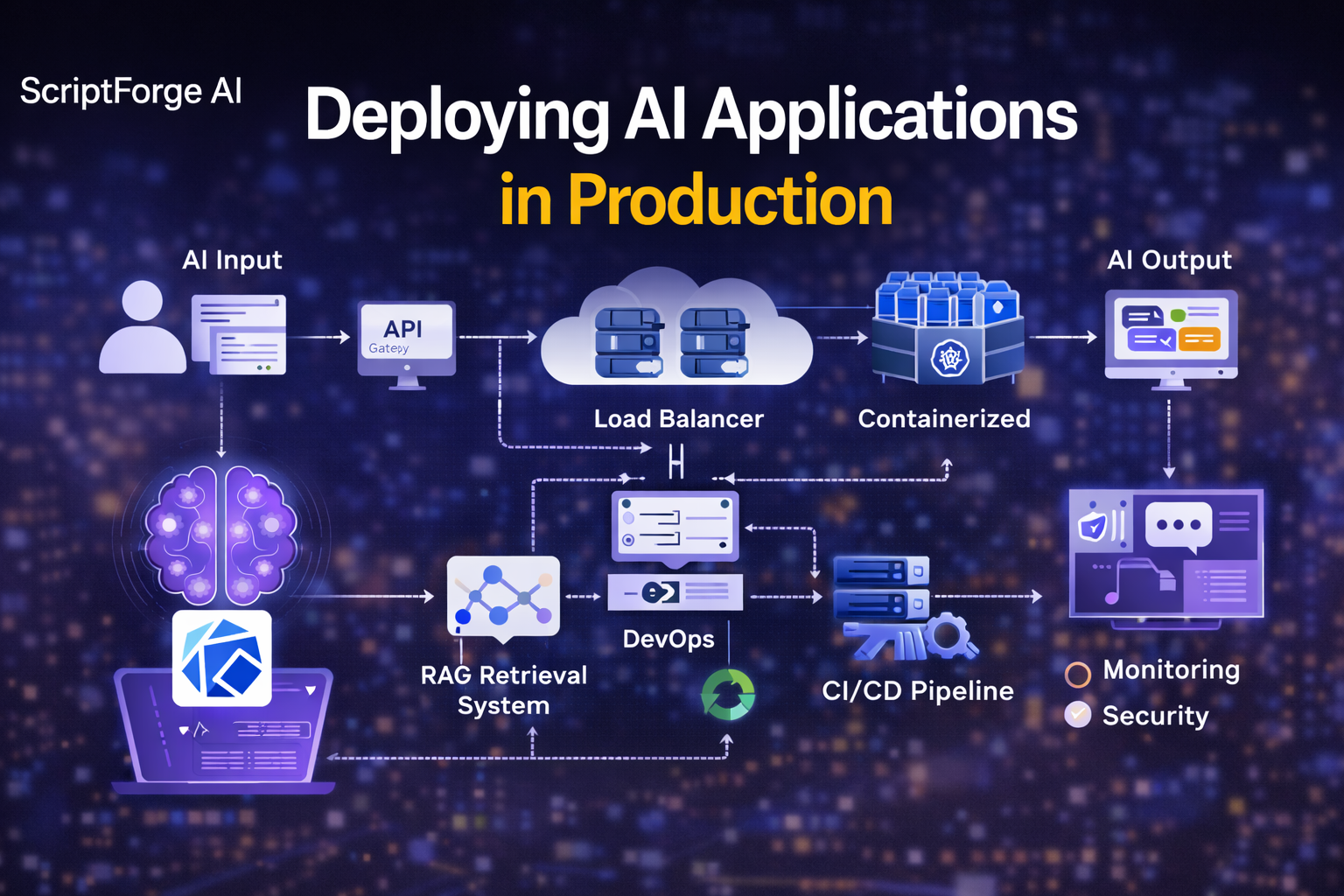
Learn how to deploy production-ready AI applications using LLMs, RAG systems, APIs, and scalable infrastructure with best practices from real-world engineering.
Building an AI prototype is easy. Deploying a reliable, scalable AI system in production is not.
Modern AI applications powered by Large Language Models (LLMs) require careful design across infrastructure, reliability, cost management, and system architecture [1][2].
In this guide, we walk through how to deploy production-ready AI systems using LLMs, RAG pipelines, and scalable backend services.
What Does “Production AI” Mean?
A production AI system is one that:
- Handles real users and real data
- Is reliable and fault-tolerant
- Scales under load
- Produces consistent and safe outputs
Unlike prototypes, production systems must meet strict requirements for performance, monitoring, and security [3].
Core Architecture of AI Systems
Most production AI systems follow a layered architecture:
- Frontend: Web or mobile interface
- Backend API: Handles requests and orchestration
- LLM Layer: OpenAI, Anthropic, or open-source models
- Retrieval Layer (RAG): Vector database + embeddings
- Data Layer: Databases, logs, and storage
This layered approach aligns with modern cloud-native AI system design patterns [2][4].
If you're unfamiliar with RAG systems, read our guide on how RAG systems work.
Example: Backend API for LLM Integration (Python)
from fastapi import FastAPI
from openai import OpenAI

app = FastAPI()
client = OpenAI()

@app.post("/chat")
def chat(prompt: str):
    response = client.chat.completions.create(
        model="gpt-4.1",
        messages=[{"role": "user", "content": prompt}]
    )
    return {"response": response.choices[0].message.content}
This API pattern is commonly used for production AI services and microservice architectures [1].
Key Challenges in Production AI
1. Latency
LLMs introduce latency due to network calls and token generation processes [1].
2. Cost Management
LLM usage is billed per token, which can lead to significant operational costs without optimization [1].
3. Reliability
External AI APIs can fail, timeout, or rate-limit requests, requiring fallback strategies [2].
4. Hallucination
LLMs can generate plausible but incorrect information without grounding mechanisms [5].
Using RAG for Production Systems
Most production AI applications use Retrieval-Augmented Generation (RAG) to improve accuracy [5].
- Retrieve relevant documents
- Add them to prompt context
- Generate grounded responses
RAG significantly reduces hallucinations and improves trustworthiness by grounding responses in external data [5].
Best Practices for Production AI Deployment
- Use structured prompts (see prompt engineering guide)
- Implement retries and fallback logic
- Cache repeated responses
- Use rate limiting
- Monitor latency and errors
These practices align with cloud AI deployment recommendations from major providers [2][3].
Monitoring and Observability
Production AI systems must be monitored continuously to ensure reliability and performance [3].
- Track API latency
- Monitor error rates
- Log prompts and outputs
- Measure user interactions
Tools like Datadog, Prometheus, and OpenTelemetry are commonly used in production environments.
Scaling AI Systems
To handle growth:
- Use containerization (Docker)
- Deploy on Kubernetes or serverless platforms
- Use autoscaling for APIs
- Distribute workloads across regions
Cloud providers like AWS, Google Cloud, and Azure provide built-in capabilities for scaling AI workloads [2][3].
Security Considerations
- Protect API keys and secrets
- Validate user inputs
- Prevent prompt injection attacks
- Limit data exposure
Prompt injection and LLM-specific vulnerabilities are documented in modern AI security research [6].
Conclusion
Deploying AI applications requires more than calling an API. It involves designing systems that are scalable, reliable, and secure.
By combining LLMs with RAG, structured prompts, and strong backend infrastructure, developers can build powerful production-ready AI applications.
Related Reading
Work With ScriptForge
At ScriptForge, we build scalable AI systems—from LLM integrations to full production deployments.
Explore AI Development Services
References
- OpenAI API Documentation — https://platform.openai.com/docs
- Google Cloud Architecture Center (AI/ML Systems) — https://cloud.google.com/architecture/ai-ml
- AWS Well-Architected Machine Learning Lens — https://docs.aws.amazon.com/wellarchitected/latest/machine-learning-lens/welcome.html
- Microsoft Azure AI Architecture — https://learn.microsoft.com/en-us/azure/architecture/ai-ml/
- Stanford CRFM (Foundation Models Research) — https://crfm.stanford.edu/
- OWASP Top 10 for LLM Applications — https://owasp.org/www-project-top-10-for-large-language-model-applications/